
Three stories
Telling tales about objects
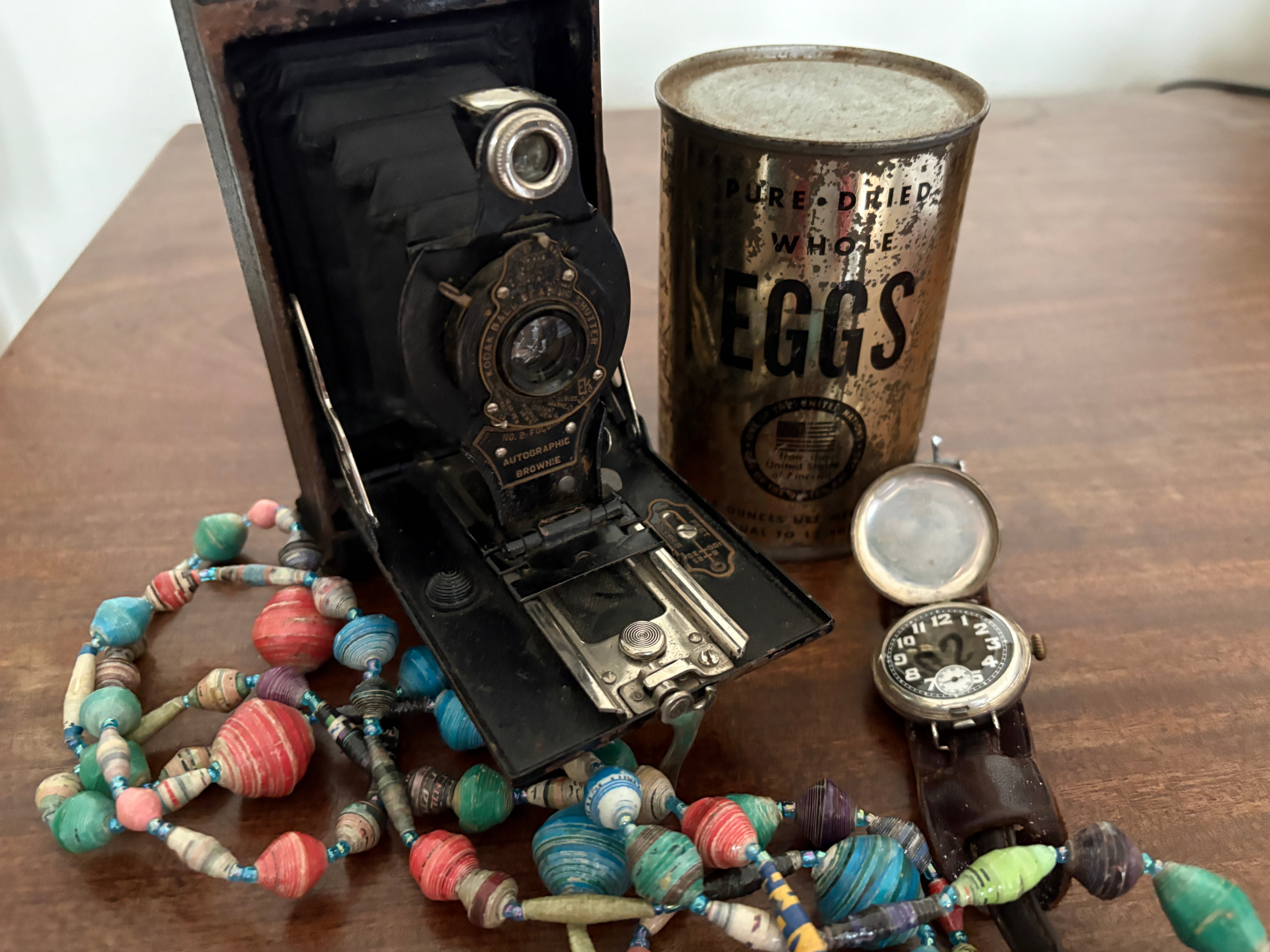
My friend and colleague Laura Davis Stored Honey said recently that I always have a good story. As a museum curator we tell and record stories about our collections.
This week I was working with a group of archivists to explore how to write object labels and text for exhibition and interpretation. We talked about writing for a reading age of 10 (the average in the UK), putting the fun and exciting bits at the start to grab the reader’s attention and using a very small number of words. We aim to tell people something new, to make them go ‘oooo I didn’t know that’. This can be difficult because we all bring our own stories and ideas. I recommend that exhibition text should be less than 120 words per panel and the labels which sit alongside objects should be about 40 words.
We began with the idea that each object (or group of objects) could tell three stories. My advice is that as curators we can’t tell all three stories, so we have to select one to focus on. The photograph shows the objects I took along to the text writing workshop. They each have stories.
The easiest story is where it came from and where or how it was made. The tin of eggs are from a time of rationing during the World War II, kept by my grandparents for an emergency.
The second story we could tell is a more contextual one, which introduces the history of a place or shows how the objects connect together or explains the functionality. The camera belonged to my grandfather a keen photographer and the moveable bellows allowed the user to focus the image.
The final story is a personal one and my favourite. Who owned or used it, have they left a mark or a scuff through use, where their story has been added? The watch is a style used by pilots and was found on the hills above Dublin, by my grandfather. He was told he could keep it as no one had claimed it. I wonder about the dents and how they got there.
My label of 36 words below is for the beads which are mine.
Brought back
I bought these beads when I lived in Malawi. They are made from recycled paper rolled and varnished. I added a matching set to a display about traditional jewellery in the museum in Blantyre.